
The Other Side of Anger
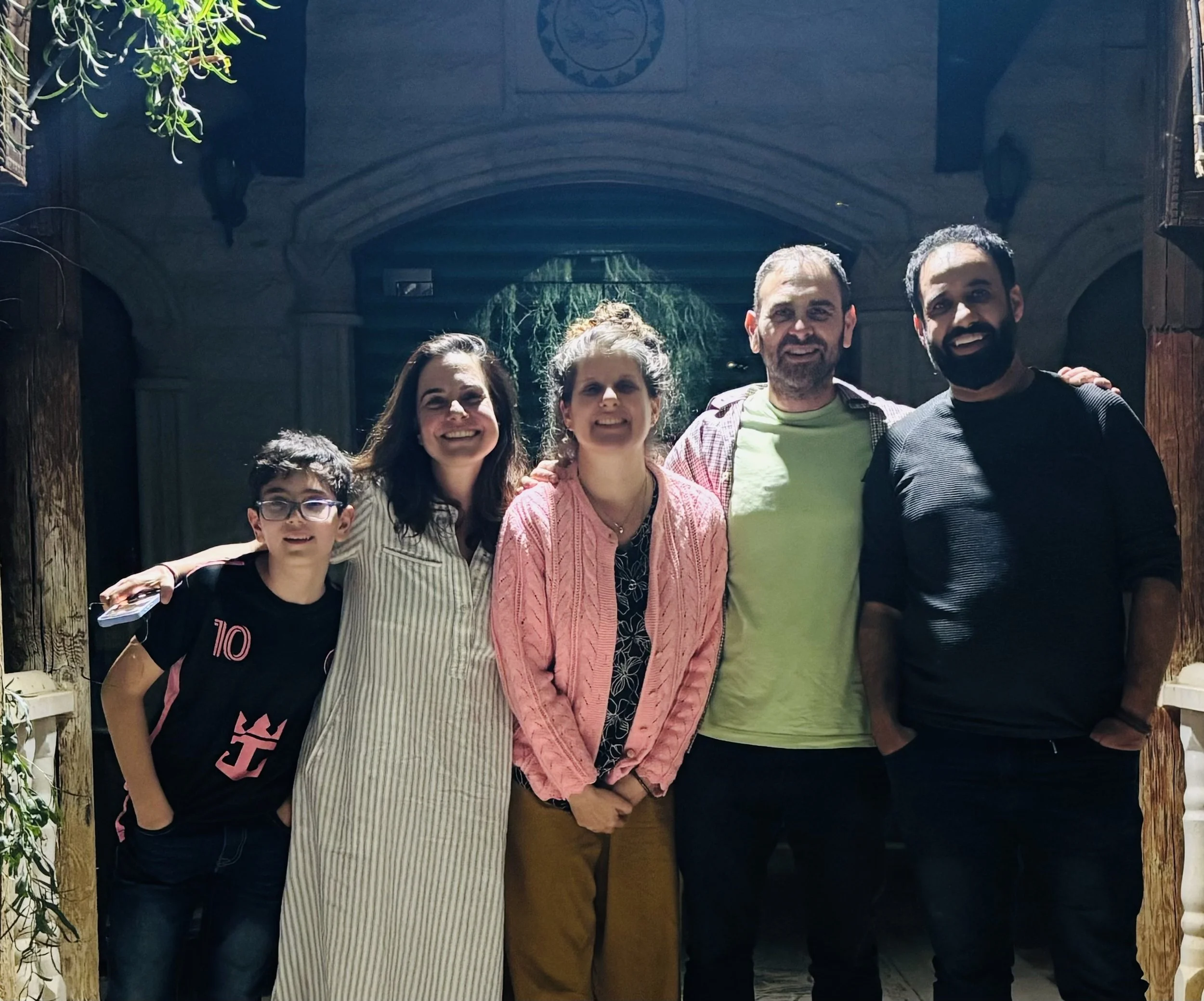
Ezzy, Erika, Racheli, me and Mousa
Dear friends,
We’re driving down through the Judean desert into the Jordan Valley. The rains were abundant this year, and the dusty hills are painted over with a delicate layer of green. We meet Mousa at a junction outside of Jericho. Mousa is a warm, smart, peace activist from the West Bank Village of Katana. A few hundred meters from Katana, inside the green line, sits the Jewish village of Nataf, where my childhood friend Racheli lives. A few months ago, Racheli joined a small but growing group of Israelis looking for ways to support families in Gaza through the winter. She called me asking if I would donate to Mousa‘s extended family, around 80 souls, who live in different parts of the Gaza Strip. Thanks to Maia and many of you, the Shul has so far raised $10,000 for the family. So it was exciting and important that we meet.
There are eight of us at this meeting outside an ancient Christian church by the Jordan River. Racheli and her son, Teobi, Mousa and his friend Nahla, two of my boys, Erika and me. The kids are playing soccer while the five of us sit down on a picnic table. We hear about Mousa’s family in Gaza, and their struggles. After losing many family members during the war, they were holding out okay thanks to the donations, but now, perhaps toward Ramadan, food has become scarcer, and danger abundant.
When we ask about the process of the money going into Gaza, he shares with us that his family was initially reluctant to receive money from Israelis. His mother didn’t like the idea, and neither did the others. Eventually, though, as Mousa explained more who these people donating are, and the goodwill on the part of the Israelis that he’s met in the peace movement, his family opened up to it. They also began hearing of other ventures bringing together Israelis and Palestinians that were starting to gain traction in Gaza. Soon they would stop trying to hide the fact that they’re receiving money from Israelis, and Jews around the world.
As Mousa shares with us how he’s seen people‘s attitudes change, some hope appears in his voice - not hope as some abstract concept, but as a simple reality of seeing how things change. He tells us that he thinks the most important age group we have to reach is the 16 to 18-year-olds, when Erika chimes in. She describes a long conversation she had the day before in the Jerusalem marketplace, or Shuk, with a 16-year-old settler. It began when he asked her for money to support Israeli soldiers and she said she’d rather support Gazans right now. At one point in their long conversation, after describing how he feared for his father when he fought in the war, he told her that he hadn’t contemplated the idea of having compassion for the people in Gaza. Erika could see this sweet young man opening up to different realities at that moment. And she describes the conversation as eye and heart opening for her as well.
“But is it the same conversation with a 16-year-old Israeli and a 16-year-old Palestinian?” I ask. “I don’t even understand how the two of you,” I turn to Nahla and Mousa, “are speaking to us without tremendous anger at what you’ve been through and what you go through every day. Mousa, a few minutes ago you told us that 12 close members of your family were killed in the war. Before that you shared how you held your cousin in your arms as he died from an IDF bullet. How can you sit here to have this conversation with us?”
Nahla and Mousa briefly look at each other. While I was speaking, I noticed Nahla put her hands together over her forehead in what seemed like prayer. Mousa tells us that Nahla has never spoken to an Israeli before. She was planning on staying in the car, she says. Up until this point, Nahla, a lovely young woman from Nablus wearing a black hijab, has been all smiles and warmth. If she was harboring resentment, we didn’t feel it, even after Racheli mentioned her military service. Now she becomes serious and admits her struggle.
“I’m a teacher in a high school in Ramallah,” she says. “Last week I took a risk, which I wasn’t at all sure of. I brought in a story about the coexistence group, Seeds of Peace, which brings together, young Israelis and Palestinians for a summer camp. I didn’t know how my students would react when I asked them to enact a short play in class about an Israeli and a Palestinian teenager meeting for the first time. I was surprised at how open my students were to the exercise.” The way she speaks about it gives me the sense that it was an experience that offered her a tiny sliver of hope.
Before we leave, Mousa invites us to Ramallah to break the fast of the first day of Ramadan together a few days later. “I’ll cook,” Nahla says. “No, please no,” Mousa laughs, “she’s a terrible cook!” We embrace and say goodbye.
On the way back to Jerusalem, I call another Palestinian activist friend from Jericho, who many of you know as well, because he spoke at our Yom Kippur service a year and a half ago. Then, Osama had been filled with reverence and goodwill, looking to bring some change and hope to his situation. Now, he can’t hide his anger and depression. “A week ago the army came in and killed my neighbor. Two weeks before that another one.” By “came in” he means the IDF entered Area A, the city of Jericho itself, which is supposed to be under Palestinian security control. “I’m debating between leaving for good or burying my head in the sand,” he says. “The peace industry has failed,” he says. “Even the children of my Israeli activist friends now serve in the army. What kind of progress is that?” When I ask him what we should do he admits he doesn’t know. “Think outside the box, something very different,” he offers.
That evening, as I carry the hope and despair from two different Palestinians, I find myself at another complex event: the big religious wedding of the daughter of another activist that many of you have met and listened to at the Shul, Rabbi Arik Ascherman. As you may remember, Rav Arik spends most his time in Palestinian villages under threat practicing protective presence. I’m used to seeing him act out his rabbinate in those types of situations. So when I got invited to see him oversee his daughter’s Chuppah I had to go.
The wedding is full of energy. Dozens of young religious men dance around the groom singing as he makes his way over to see his bride, herself surrounded by dozens of young religious women singing. Here and there you can spot some of the old guard of Jerusalem royalty, authors, rabbis and academics among the young, orthodox men, some with rifles hanging around their shoulders. And there is also a group of secular activists who have spent days and nights with Rav Arik in the villages. The father of the bride looks happier than I’ve ever seen him. Under the chuppah Rav Arik speaks of the many generations of family members who came before them who are present there with them, along with the Shechinah, the presence of God, which is always there at weddings.
The ceremony ends with the bride and groom again surrounded by happy hordes singing and dancing with immense power and joy. I find myself standing next to the partner of one of the secular activists. “How does Arik accept all of these religious Zionists so warmly,” she wonders. “Doesn’t it bother him?” “Arik,” I explain, “is an elevated being in that regard. He is somehow able to see the humanity in every person. He is able to do that even with the nastiest settlers who curse and yell and beat him up. So here, he is connecting to the beauty of these people, all the love and positivity that is streaming through them tonight.”
As I write this down now, this Friday afternoon before Shabbat comes in, I can see the connection between the question she asked me and the question about anger I asked Mousa and Nahla. Some people are sometimes able to maintain the presence of mind to take in the multi dimensional reality of the people in front of their eyes, even as they work through their harsh criticism and rage at what they are doing. And most people most of the time fall prey to the often justified feelings of victimization and rage, and allow those feelings to turn the living human beings in front of them into faceless, flat expressions of right or wrong. Don’t get me wrong: I’m not judging. God gave us those feelings for a reason. But perhaps part of that reason is to challenge us to see through them into the other side of anger, where there is abundant peace and endless space.
Two days after that wedding, Erika and my father went down to sit in protective presence with the families of a village that had been attacked by settlers the night before. They watched another village pack up and leave, succumbing to the devastatingly successful ethnic cleansing campaign in Area C of the West Bank. Rav Arik was there after they left and was arrested by Israeli security forces as he tried to protect another family from an attack. By now he’s back in Jerusalem with his family. I hope he’ll take a shabbat off of this holy work, and enjoy Shabbat with his now married daughter and son-in-law.
There are huge amounts of gorgeous wildflowers all over the Jerusalem Hills. We have been marveling at them all week long. Through the difficulty and Israel’s shattered reality, God seems to be whispering to us: see through the horror to the beauty sprouting everywhere beyond it. At least on Shabbat, if not the rest of the week.
Shabbat shalom,
Rabbi Misha