
The Usefulness of Despair
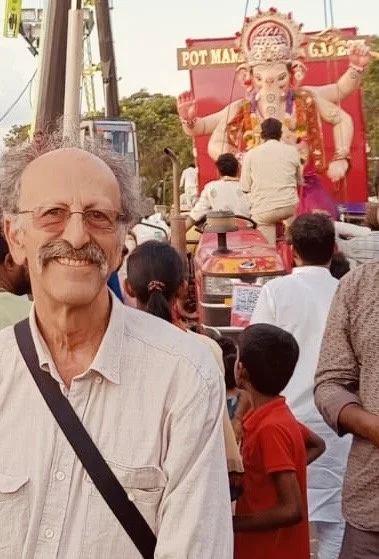
My father, David Shulman last week in Hyderabad, India, at a Hindu festival in which 50,000 statues of Ganesh were drowned in the Hussein Saggar Lake. You can see one of them being pulled up with a crane behind him.
Dear friends,
I'm excited to share with you that my father, David Shulman will be visiting from Jerusalem for the holidays and will be our main speaker on Yom Kippur morning. Many of you have met him, read his writing in the NYRB or other publications or heard him speak at the Shul.
There are all kinds of reasons to hear him speak this year: His principled, uncompromising insider's read on Israel/Palestine, gained by decades of activism to end the occupation and protective presence in the West Bank. His world renowned expertise on the ritual life, music, arts and religion of India, (which earned him a MacArthur Award and the Israel Prize, among many other accolades), where he has gained a deeper understanding than anyone I know of the concept of pilgrimage, our theme this year. My dad has made pilgrimage to more temples in Southern India than most Hindus complete in ten lifetimes, spent time in half the mosques and holy sites of Iran before the revolution, and tells me his favorite place in Jerusalem when he was a young American student at Hebrew University in the late sixties was, of course, Haram El Sharif, which the Jews call Temple Mount. His profound storytelling talent, expansive mind and restless search for beauty, even amidst the ruins.
But the reason I invited him to speak this year is because of his relationship with despair. It's a real relationship that strengthens him and plays a big role in keeping him actively following what his heart knows he should do. His never ending work on protective presence for Palestinians under threat in the West Bank
is infused, to a large degree, with this liberating despair that allows him to walk the paths of righteousness with his fellow activists week after week.
In the opening chapter of his book, Freedom and Despair, which outlines some of his uplifting thinking on this question, he writes about the internal struggle of the activist:
"But the real problem with getting out of bed before dawn is the insistent, unnerving inner voice that says: it’s all for nothing. It’s anyway a lost cause. We can’t make much of a difference. A monumental crime is going on, literally our by hour, and we are not able to stop it. We are banging our heads against a wall. No one even notices what we do. Our victories, such as they are, our minute, our ultimate defeat certain. And so on. This voice is astonishingly versatile in its range and cleverness. It’s much smarter than I am. So why not stay in bed?
But I always go anyway, and I’ll tell you why."
I invite you to read the full chapter HERE.
We are looking for the internal, energizing force that will keep us walking the road of goodness with equanimity and strength. I'm hopeful that my beloved father will help us find it.
If you haven't signed up for the holidays, please do, (and if the finances are tough this year, as they are for many of us, let us know. No one will be left out).
Shabbat Shalom,
Rabbi Misha