
Jabra's Boots
Dear friends,
I had been arguing with my boys all week about Christmas. They said it’s not a religious holiday and “nobody treats it that way,” while I insisted that to many Christians the holiday's religious roots are alive and well, and are the opposite of the capitalist frenzy it often evokes in the US. And then, yesterday morning I happened upon a beautiful little Christmas story, which captured something of that anticapitalist essence I was trying to express to my boys. I found it in the lovely autobiography of Jabra Ibrahim Jabra, a Palestinian Christian from Bethlehem called The First Well.
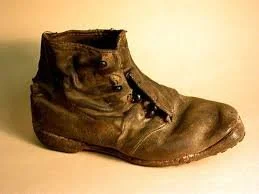
Shoes were a luxury for Jabra, who grew up poor in the 1920’s. In an earlier episode we read about how his father took a tire, cut a sole out of it and made it into a pair of shoes for his son. And then, the week before Christmas, the priest at the local church gives Jabra a gift – a brand-new pair of boots. He runs home ecstatic to show his parents, and they rejoice with him. Lying in bed at night, he realizes he hasn’t tried them on for size. So he sneaks out of bed while everyone is asleep and tests one of the boots on. It’s a perfect fit. In the morning, however, his mother informs him that they have no money for the Christmas meal. They had been fasting, with no meat or eggs for 25 days, and needed to have a Christmas feast. So they’re going to sell the new boots for fifteen grush and take little Jabra to Jerusalem, where they can find used shoes for two grush in the Jewish quarter. Devastated Jabra returns from the trip to Jerusalem with his mother, and “takes off his shoes like you would take off handcuffs.”
Here is Jabra’s description of the holiday that year:
Even though we were up late, on Christmas Eve we couldn’t sleep more than three or four hours, anxiously awaiting the break of dawn. My mother woke up the family, lit the lamp and said “can’t you hear the angel’s bell?” This was the bell that would ring from the copula of the Church of the Nativity, filling the night air and announcing the final stretch of the night.
With no hesitation, my brother Yusuf, my father and I stepped out of bed and got dressed. My mom put two coats on me one ontop of the other, and we went out into the darkness, rubbing our hands together from the cold as we marched swiftly towards the Church of the Nativity. The square in front of the church was shining under the drizzling rain. The light from the few electrical lights around the square was ricocheting off of its long tiles. The halwa sellers were standing at the sides of the Piazza, shielding themselves from the rain by the large stone walls. The grilled meat sellers were fanning the coals, which colored their faces in red as they loudly invited people to buy their food. The chestnut sellers were tending their fires too, keeping the coals that heated them and their precious chestnuts hot. Old men were carrying around enormous jugs, the height of a person, at the bottom of which were burning coals, and they kept yelling, “Hot Sahlab! Hot Sahlab!” There was never ending movement coming from every direction, as if none of these people had slept that entire night.
We entered through the low, narrow stone gate into the wide church, with its high, high ceilings. It was dark inside, despite the hundreds of colorful oil lamps, whose thin flames were dancing lake stars between the large marble columns. Candles were burning in the center of the hall. Around them, thousands of pilgrims crowded together, while the choir sang Byzantine Psalms in loud voices, which blended with the bells ringing over the roof of the basilica.
We met many friends, who like us had come to participate in the post-midnight mass. We joined the tight crowd of men, women and children walking down the smooth marble stairs into the cave in which the Messiah was born. The cave was engulfed in clouds of incense and candle smoke, and was warm from the breath of all the praying people. A priest was reading the story of the nativity from the New Testament in a voice cracked with age. He read it as though it were his first time: he described the shepherds who wished to warm themselves and their flocks that night, while the snow covered the hilly grazing fields. Behold! In front of their eyes suddenly appeared the entire army of the heavens, lighting up the sky with moonbeams, announcing the birth of their savior in Bethlehem while the angels sang over and over again: “Glory to God above, peace upon the Earth, and to the people good will!”
As we walked away from the church, and the echoes of the Psalms blended with the softening ringing of the bells, the rising sun seemed to be battling the clouds at the edge of the blue horizon. I watched it with deep pleasure, imagining the choirs of angels filling the universe with song and good tidings, as though at last I actually saw them with my own eyes.
At home, I found my mother and grandmother preparing the holiday dishes. The big pot over the fire was steaming. The room was full of the smell of the meat that my mother had bought with the money that was left over from selling my beautiful boots, the boots which my heart had forgotten in the flurry of the holiday and its melodies.
Everyone delighted in the delicacies we ate that morning, concluding the grueling 25-day fast. After we ate, as my mom pulled the “tablecloth” off the floor and began to fold it up, my father leaned back on a pillow and said: “I wish, Miriam, that you hadn’t sold those boots. We took them away from him, and now it’s the holiday.”
“What has passed is passed,” my mother answered. “May God help you, and in the future we will buy him one thousand pairs of boots!”
For years later, when Christmas would come, I would remember those boots that I never got to wear – but quickly they would again be forgotten from my heart in the noise and gladness of the holiday – or in the merciless, heavy sadness that the holidays brought with them in other years.
Shabbat shalom and happy holidays,
Rabbi Misha
PS. If you haven't already, please join Maia's campaign to support the Khitawi family in Gaza through the winter.