
Leibowitz
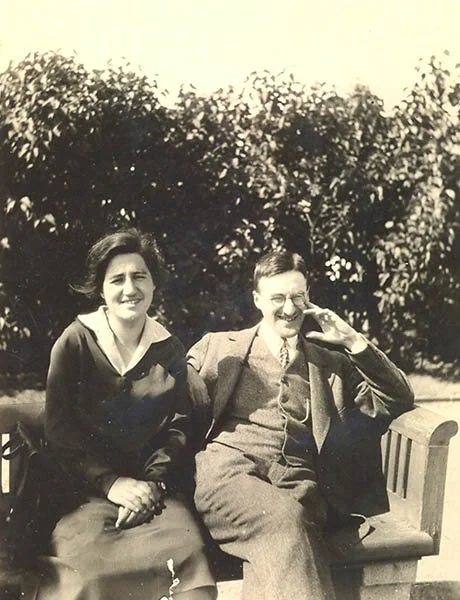
Nechama and Yishayahu Leibowitz
Dear friends,
Before I share some thoughts about two of the greatest Jewish minds of the twentieth century, I’d like to invite you to our Shabbat this evening at First Pres. I know we’re all a bit Jewed out after the holidays, but it’s going to be so nice to come back to our musical Shabbatot. And there will be dinner!
Two of the greatest teachers our people produced in the last century came from the same household. They were born in 1903 and 1905 in Riga, then part of the Russian empire, where they were homeschooled with private teachers and raised as Orthodox Jews. After the revolution they moved with their family to Berlin, where both would pass the matriculation exams at age 16 without ever having attended school. A few years later they earned their PHD’s, and then in 1930 fulfilled their ancestral dream and moved to Jerusalem, where they would grow into such legendary stature that by the time I came around about fifty years later, their name, Leibowitz was couched in an aura of awe and reverence unlike any other.
This isn’t just a history lesson. It’s an invitation. But I’ll get to that in a minute.
The younger of the two siblings, Nechama received the Israel Prize, the state’s highest honor already in 1956, for her tremendous influence on Torah study. Especially at that time this wasn’t a field flush with feminine voices. Besides teaching at Hebrew University, she was the teacher of thousands of students:
“In 1942, some of Leibowitz’s students decided that they wanted to continue studying her material even after the school year had ended. Acceding to their request, Leibowitz began mailing them her worksheets, which contained commentaries unavailable at the time and, furthermore, challenged them with difficult questions, with every answer checked personally by Leibowitz. Word spread to friends and neighbors, who also wished to fill out these sheets. Eventually the correspondents ran into the thousands: young and old, religious and secular, kibbutzniks and city-dwellers. Thus Leibowitz functioned as a one-woman Open University correspondence course for over thirty years without ever receiving remuneration.”
Yishayahu, in the meantime made a name for himself far beyond his work as a Professor of Biochemistry at Hebrew University. Considered the greatest Israeli philosopher to this day, Yishayahu had high hopes for the Jewish state when it came into being. Zionism, he believed, offered a "historic opportunity for the renewed political independence of the Jewish people to test the values of Jewish heritage against the realities of modern statehood." Within a few years he had begun to sense that the Jewish state was completely failing to uphold the values of their tradition. When 1967 came around he immediately warned that if Israel held onto the conquered territories it “would necessarily become a secret-police state, with all that this implies for education, free speech, and democratic institutions. The corruption characteristic of every colonial regime would also prevail in the state of Israel.”
When that occupation was nearing three full decades Leibowitz was announced as the winner of the Israel Prize. He used the platform to call on Israelis to refuse to serve in the army in the Occupied Territories, where they would be forced to act like what he called “Judeo-Nazis.” Nowadays, one of the most common T-shirts at pro-democracy or anti-war protests in Israel is a picture of Leibowitz over the words: אמרתי לכם, “I told you so.”
Both Nechama and Yishayahu were driven by Torah. They lived through some of the most dramatic upheavals our people have ever known and remained deeply religious until they passed in the 1990’s. Both left us traces of their deep understanding of Torah in their highly approachable books about the weekly parsha.
Which brings me back to my invitation.
A group of us have been meeting weekly on Zoom to study Torah for some years now. This year, we are going to devote our study to the teachings of Nechama and Yishayahu Leibowitz. We have a great deal to learn from them, not only about Judaism, but about how to live in challenging times.
I’d like to invite you to JOIN US. We meet every Thursday at noon for an hour, and this year we will also add some evening meetings for those who can’t take a mid-week lunch break. No prior knowledge, nor commitment is needed. Everyone is welcome. The first evening meeting will be Tuesday, November 4th. Studying Torah is one of the great things we Jews know how to do. If you haven’t done it in a while, it’s worth a go.
I’ll give a teaser with some of Yishayahu’s thinking on the contemporary echoes of the story of Noah’s Ark this evening at Shabbat.
I hope to see you there.
shabbat shalom,
Rabbi Misha