
What do we do with our love?
Dear friends,
As we wait with bated breath for the return of the hostages and the partial withdrawal of the Israeli troops, we are all praying for this awful war to truly be over. Perhaps our fervent prayers on the holidays contributed to reaching this deal.
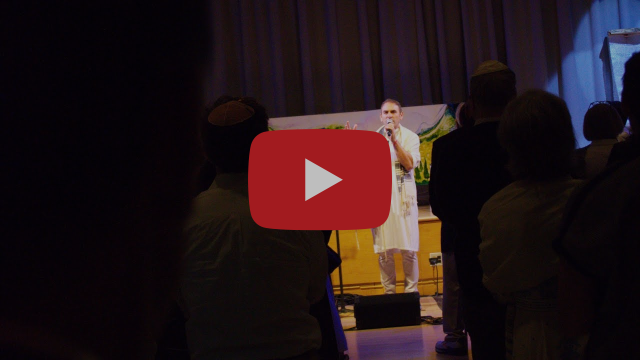
So many of you have reached out to me asking for the text of my Kol Nidrei dvar Torah that I decided I'd share it with you all here. The text is below, and the recording above. And at the bottom of the email you can also find the recording of my father's moving speech, in case you missed the morning service.
What do we do with our love? / Kol Nidrei 5786
I once asked Rabbi Arik Ascherman, who ran Rabbis for Human Rights for 20 years and is active in the West Bank with his organization Torat Tzedek, why he is a Rabbi and not just a regular activist. What is your Jewish drive? I asked him. “I go back to the very beginning of the Torah,” he said. “The first two words, Bereshit Bara. In the beginning, God created. These words tell me that there is ultimately a structure to the universe. For six days we go around, acting as though the world is up to us, and on the seventh day we remind ourselves that it is a created world, meaning it has a structure. It has meaning. It has something we might call justice.”
It’s actually easy to see this justice. All you have to do is go take a walk in the woods, or look at the ocean, or the stars somewhere that isn’t New York City. You can look at your body, the intricate, incredibly complex system that somehow keeps going, allowing us to see and move and walk and talk and breathe.
These days, it seems very much like there is no structure, there is no justice, and even truth seems up in the air. But that’s not the case. We each know inside of us what is good and what is not, what is right and what is wrong, what is just and what is not. Like the universe has a structure and laws that cannot be broken, even if you try, something inside of us knows the structure of human justice. We know that behavior has consequences.
I know that what I do, whether for good or bad, will have emanations outward into the world. I don’t know about reward and punishment in this life or the next. But I do see how what I do keeps moving out there in the world and becomes a part of everything else. I see how what other people do impacts me. I see how the actions of those who came before me make me walk and think a certain way.
When I was in Jerusalem, this summer, I spoke to a Palestinian man in the Old City. In the middle of a conversation about politics, he said something simple to me. “You and I don’t decide what happens.”
I want to tell you something that I think is very important to understand. In the eyes of our tradition, under the gaze of the eternal God, you are only responsible for your own actions. You are not responsible for what the person who’s sitting to your right or to your left is doing, nor are you responsible for the behavior or choices of your elected representatives, neither here nor anywhere else in the world. When you come at the end of your days in front of yourself and are asked, did you live properly, the question is not about anyone but you.
Today we ask ourselves: Did you live properly this year? When your partner was sick, did you show up and take care of them? When your child needed you to help them cross the monkey bars did you come? When your parent called did you stop what you were doing, and answer? Were you there for your loved ones? These are the basic questions. And then there are other questions that go far beyond this, like what did you do when your people committed horrible crimes against another nation? When your neighbor was stripped of her rights and her family, how did you respond? When you saw authoritarianism descendupon your country, did you act?
In all of these questions, the answer has nothing to do with the result. You were not in charge of healing your loved one, you were just in charge of making them chicken soup. Or calling the doctor or taking them to the emergency room. Neither were you in charge of stopping the starvation campaign in Gaza, or of returning the hostages home, or of ending antisemitism or of keeping the non-profit sector from collapsing, or of protecting Trans rights or of keeping the world from continuing to heat. You are not the person who is going to do any of that. No single person is. It’s true, as Heschel said, that in a certain sense, all of us are responsible. But our responsibility is to do the right thing. Whether what we were working toward happens or not is in the hands of God.
If you were standing in front of God right now, God would simply want to know if you did your part. Were you walking towards Jerusalem this year or not? And I don’t mean Jerusalem, the capital of the modern state of Israel, that historical oddity. I mean Jerusalem, the abode of peace and wholeness, the place of goodness and justice and truth.
And as it happens, you are standing before Her right now. So, ask yourself: were you walking towards the city of wholeness this year? How much of it did you spend frozen? Hiding? Avoiding? Delaying? Conveniently compromising? Self-flagellating? How much of it did you spend walking in the wrong direction?
We are here to correct course. Not of world politics, of the United States of America, or New York City. We are here to correct the course of our own feet.
The foundation of the world is a single rock that sits behind the Western Wall under the golden dome in the holy city of Jerusalem. That same rock is planted deep in our souls. Sometimes, when we manage to get far beyond the appearances of this world and know the truth and see the goodness, we are able totouch that rock. Then we are suddenly reminded that we don’t only have anxiety, fear, disappointment, rage. We also have a huge surplus of love.
I think that one of our central problems these days is that we do not have an answer to the question: what do we do with our love? What do we do with our love of Israel, which so many of us have been tending to our entire lives? What do we do with our love of this country that we live in, and this town we walk around in? What do we do with our love of humanity, and each member of it? What do we do with our love of this earth and all of the creatures and plants and wonders in it? What do we do with our love of ourselves in the face of what we perceive to be ongoing failures?
In order to answer this question, we might be wise to examine one historical tale that kept our people alive when it looked like all was lost.
Two thousand years ago the Romans were laying siege to Jerusalem. Just like today, people felt entirely helpless. Inside the walls the ultra-nationalist Jewshad taken over, demanding everyone join in a suicide battle against the Romans. But there was one person in Jerusalem who read the map with cold clarityand saw an opportunity. He was the only one at the time who knew what to do with his love.
Rabban Yochanan Ben Zakai got his students to smuggle him out of Jerusalem the only way that the Romans let anyone out - in a coffin. At the cemetery outside the walls, he got out of that coffin and went straight to the headquarters of the Roman legion to speak to their commander.
The rabbi did not ask for mercy. He knew it was over, and both Jerusalem and the temple would burn. He saw that the Jewish people had lost their way and wasn’t about to try and convince the Roman commander to spare the holy site where they prayed for war and vengeance. He asked for something else instead: a place where the sages could study and create a new version of Judaism. “Give me Yavneh and its sages,” he famously said. Yavneh had no significance whatsoever at the time. It’s as though he asked for Secaucus instead of New York City. It was the learning that was important, not the place.
Thanks to him, when the temple burned, and that chapter in our history ended, a new one began. Everything that we are doing tonight comes out of Yavneh. The entirety of what we call Judaism is from there. The Talmud is from there. These rabbis created a new Judaism based on studying and re-interpreting the old one that had run the people toward what the sages called “Sinat Chinam,” baseless hatred, which is what the rabbis considered to be the root cause of the destruction of Jerusalem.
We are Yavneh. Right here. We are tasked not just with keeping the flame alive, but with rediscovering the humanity and the revolutionary spirit within our ancient tradition. No matter who may be against us, our faith is not one that calls on us to starve millions, to bomb hospitals, to kill thousands of children, to abandon our own captured loved ones to their deaths. This community and so many others like it in New York, in LA, in Tel Aviv and all over are Yavneh now. Today we are the Ben Zakai’s being smuggled out in that coffin, about to face the Roman commander. Tomorrow, we begin the exciting task of honoring our predecessors by re-interpreting the holy Torah, so that those who come after us can embrace our Tree of Life, and grow new branches and leaves onto it.
What do we do with our love? Bereshit bara. We invite it to guide us towards new ways of caring for one another and lifting up the image of God. We use thislove as the foundation of our new temple.
My friends, we are on a pilgrimage. One day it will end we will come in front of that shining rock of our lives and see ourselves. When that happens, we need to be able to tell that rock: I spent my life walking towards You. I did what the prophet Micah suggested: “act justly, love kindness and walk humbly with your God.” I did that when I could see the fruits of my actions, and I did that when I couldn’t. I walked the paths of this beautiful, beautiful world with kindness and love for all of Your creations. I didn’t stop. Even when I had no idea how to love and everyone told me to stop, I kept on loving. I kept seeking the peace of Jerusalem with every step I took.
Moadim lesimcha, shabbat shalom,
Rabbi Misha