
What a beautiful opening to our pilgrimage.
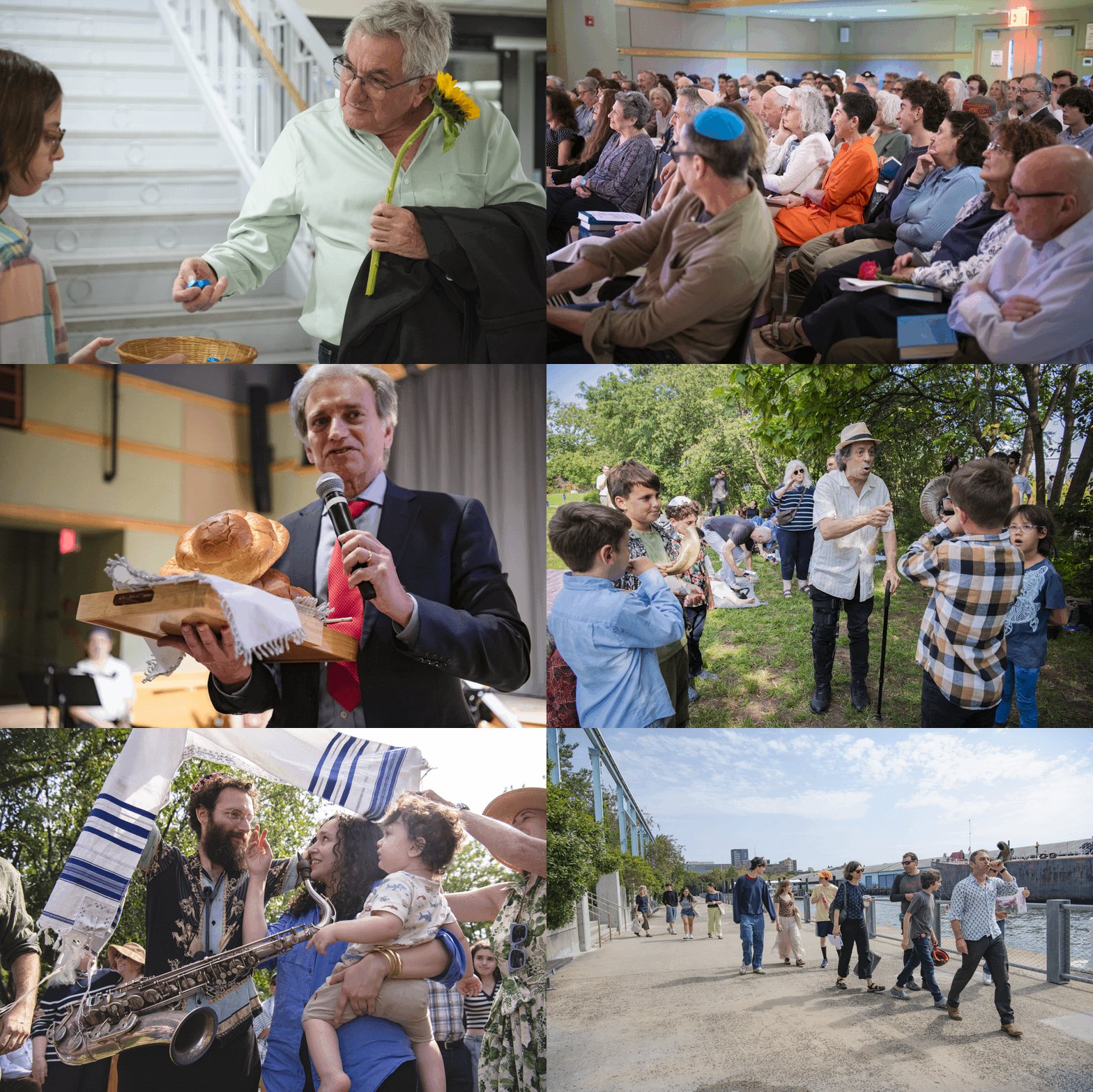
Scenes from Rosh Hashanah, as captured by Nichol Hutsel
Dear friends,
If the rest of the year will be as uplifting as our Rosh Hashanah we’re going to be just fine.
The power of coming together around ancient rituals, of music and faraway languages, of igniting the imagination towards transformation was on full display. So many breathtaking moments, in no particular order: observing the kids watch Owl, our friend from the Ramapo-Monsee-Lenape tribe burn sage and sing in his ancient language a song to invite the spirits to our gathering. Taking the gorgeous Mandala led by Suzanne Tick at the end of the night and mixing it all up into a bag of flower petals. Throwing those petals into the river the next day with a group of bright teens. Hearing Nancy thank God in Hebrew for surviving her near-death Illness, and the whole community saying in Hebrew - “may the one who granted you kindness give you every type of kindness.” Blessing 14 month old Shaya under the sun. Hearing a group of kids blow shofar under Frank London’s instruction. Walking silently, kissing the ground with the sole of my foot as per Michael Posnick’s instruction at Tashlich. And possibly the greatest moment, for me, was watching Cindy Ruskin’s Pilgrimage scroll unfurl foot by foot until this incredible piece of art that she made over the summer was fully open - all of its 33 feet(!!!), and Cindy saying “I know I had said it’s 3 yards long, but it came out 10.”
It was especially moving to me to share with you on Monday evening the stories of father-son pilgrimages that I made - with both my father and my sons in the room. For those of you who missed it, I shared how when I was 16 my dad took me to a temple at the western most point in India, and that this past year I got to take my own 16 year old (now 17), Matan on pilgrimage along the Jacobean Path to Santiago de Compostella in Spain. I offered an activity you might consider doing as part of these Days of Awe between now and Yom Kippur: go on a pilgrimage. It could be a visit to a loved one’s resting place, or some place that is especially meaningful to you in the city or around it, maybe stopping by the Bialystocker Shul in the Lower East Side, or the spot on the Bowery where CBGB’s once was, or to Mahatma Ghandi’s statue in Union Square, or anywhere else that feels like a pilgrimage to you.
On Tuesday I was wishing I could be at two places at once, because the I knew that the BeineiNewShul service uptown with Daphna and Saskia and a bunch of you was fabulous. Some of you have inquired about my words in the park in Brooklyn under that radiant sun. If you already heard them - see you on Kippur! Bring your friends. I can’t wait. If you haven’t, here they are:
We don’t know where to go. Let’s admit it. We’re living in a time that freaks us out, in a country that is going against who it’s supposed to be, while the Jewish state is behaving exactly the opposite of how we think Jews are supposed to behave. We need a change, a new direction, but we’re not sure which way to turn. Where is the holy place to return to when the whole world seems unholy? Where is the true Jerusalem, City of Peace, that we should walk toward it?
This was exactly the state of mind of the first Jews, Abraham and Sarah, at the very beginning of our people. We come from this state of mind of feeling lost in a world that is all wrong. At the height of that feeling, in the grief of losing Abraham’s father, at that moment God said to them:
לך לך מארצך וממולדתך ומבית אביך אל הארץ אשר אראך.
Walk - away from your country, from your birthplace, from your parents’ home, to the land that I will show you.
How would you feel if you heard those words? It’s scary. God isn’t even telling them where to go! They're just supposed to know where “The land that I will show you” is when they get there. These are not words that would have made me feel secure and comfortable.
But listen – beginnings don’t happen when you’re comfortable. When you know what to do. When you’re in control. When the world behaves like you expect it to. Rashi says Kol Hatchalah Kashah: every beginning is difficult. The year that my life began for real was the most challenging, most chaotic year of my life, when everything I counted on to be solid fell apart. All of my greatest blessings grew out of that year. Thank God for that year.
The Torah tells us that light was created out of chaos. Because chaos, when everything is crazy and you can’t make out any rhyme or reason for anything, doesn’t only breed fear, it also offers a type of unexpected freedom – an invitation to try things out, to wander, what Henry David Thoreau called Sauntering – walking for the sake of exploration.
That’s the freedom that Abraham and Sarah felt when they made their way to some new type of living in this “Land that I will show you.” Rashi tells us that God even told them to “enjoy their walk.” Our ancestors found ways to enjoy their walk into the unknown.
Contrary to common belief, this walk that Abraham and Sarah took was not toward the holy land. The Torah uses the name Canaan. Even when they got to Canaan, there was nothing especially holy about the place. They were the ones who made it holy, who turned it from Canaan to Israel. They walked all over it in search of holiness until they found that it had become holy. “And Abraham journeyed, walking and journeying southward,” Always toward Jerusalem. As our rabbis clarify. Always toward Jerusalem, when Jerusalem did not exist, and wouldn’t for another thousand years. Abraham understood that he had the opportunity to create new type of holiness by walking toward what he knew to be holy.
That is our task. To find new ways to walk toward what we know to be holy, just and good even when we don’t know what is going on, and we’re lost, and what was once holy suddenly looks like an abomination. To leave what we know, find new paradigms, and walk toward what we sense to be holy, until one day, which may be tomorrow and may be long after we’re gone, the paths we walked will be sacred paths, and the cities we saw go to war will be bastions of peace.
"If you’re ready to leave your mother and father, and brother and sister, and wife and child and friends, and never see them again," said Thoreau, – "if you have paid your debts and made your will, and settled all your affairs, and are a free person – then you are ready for a walk."
Are you ready for a walk?
Shabbat Shalom and gmar Chatimah Tova,
Rabbi Misha