
The Kabbalists' God
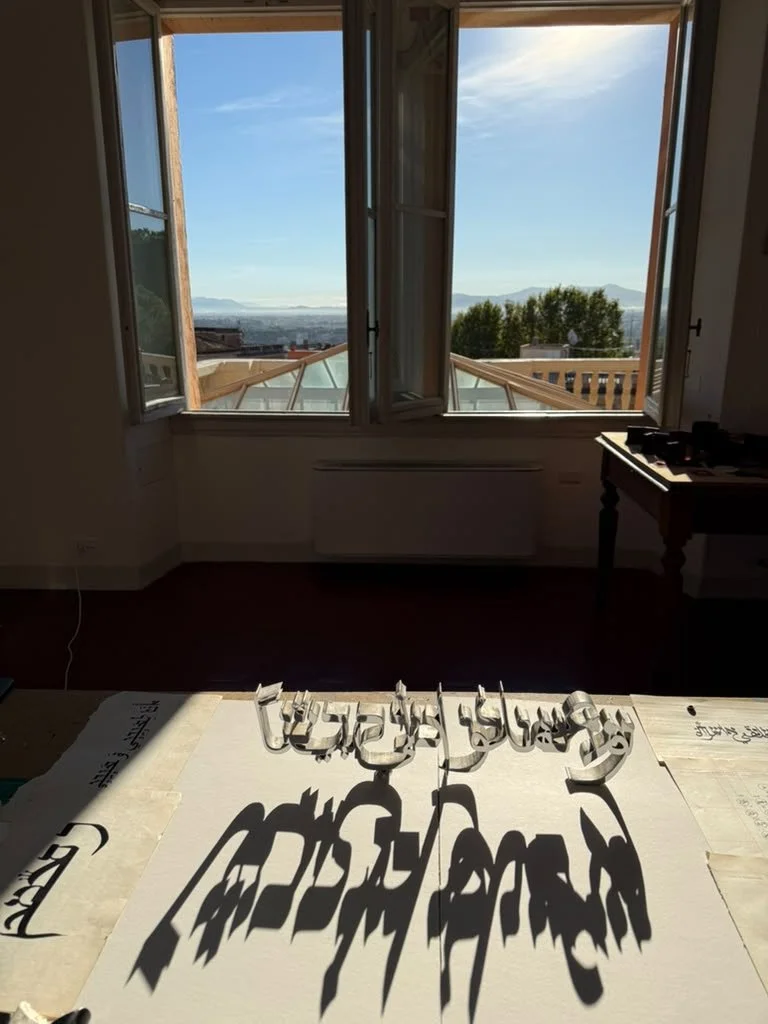
Shadows in Ghiora's Studio
Dear friends,
Finally. It took close to five decades. I had given up. I was settling into never finding it. And then, like a flash of brilliance cutting deep into my core, the words leaped out at me like a jaguar on its prey.
Maimonides taught me that anyone offering a positive definition of God is not to be trusted. We can say what god is not, not what god is. It was part of his quest to uproot any traces of physicality from our conception or the divine, and assert the North Star of our faith world to be the abstract.
Little did he know that only a few decades after his death a new - or possibly ancient - holy book would appear that would take the Jewish faith, as well as several others by storm, with a multiplicity of definitions of the divine. Some will say that it took us far deeper into the abstract than Maimonides imagined. Others, that it shattered any type of abstraction by anthropomorphising God, giving different manifestations of God genders, faces, limbs and limitations.
I’m referring to the Zohar, the greatest work of Kabbalah, or Jewish mysticism, which we have begun studying at our weekly midday Torah class, Torah Byte, and which is both expanding and demolishing our minds.
Let’s examine one example of a definition of God that we learned this week in the introduction to the Zohar.
Rabbi Elazar opened:
Lift up your eyes on high and see: who hath created these? (Isaiah 40:26).
‘“Lift up your eyes”: to which place? To that place to which all eyes are turned, called Opening of the Eyes.
There you will discover that it is the mysterious Ancient One, who exists for the question, that "created these."
There are three defining statements about God in this short passage. First, the Opening of the Eyes, or Petach Eynayim in Hebrew. In order to understand “who created these” we have to look toward the space that opens eyes. That is the space God inhabits, and the space that can lead to creation.
Then comes the phrase “the mysterious Ancient One,” or Satim Atika in Aramaic. Satim literally means blocked or unknowable. So we’re being told here about two primary aspects of the divine - ancientness and incomprehensibility.
It is the third describing phrase that popped out at me like something I’ve known forever but never came close to putting into language.
דְּקַיְמָא לַשְּׁאֵלָה
Who exists for the question.
Or in another translation: whose essence can be sought, but not found.
God is the one who exists to be asked about, to be turned toward, to be sensed but not held, to be missed, yearned for, chased after, loved from afar; to be sought but not found.
My whole life I have heard whispers of this Hebrew word, Teshuvah, meaning answer. Two of my best friends in high school Chazroo Bitshuvah, returned to the answer, meaning became religious. I always thought that giving it that name was the tradition’s biggest marketing mistake. Who cares about the answer - it’s the question that’s interesting. To return to the question - lachzor bish’ela, meaning to leave the religious life, always sounded so much more appealing to me. And I’m pretty sure it did to the Kabbalists as well. Otherwise, how could they have reached this deeply inviting, deeply satisfying definition of God: the one who exists for the question.
It’s a definition of God that is allergic to fundamentalism and its way of turning anything good into an idol. It allows you to be a Jew in the very best sense of the word: a seeker, a questioner, a wonderer and a wanderer.
There’s a character in Chekhov’s The Cherry Orchard who’s derisively called “the eternal student.” Give me a God that makes me exactly that. The one who exists for the question. Is there any better reason for anyone to exist?
I hope you join us at the soup kitchen tomorrow morning to volunteer and then celebrate Zev and Leo’s Bnai Mitzvah. And I invite you all to join us for Torah Byte every Thursday at noon on Zoom to dive into the mysteriously beautiful world of the Zohar, which definitely exists to be sought, but never found.
Shabbat shalom,
Rabbi Misha